ProviderConfig

ProviderConfig contains connectivity-related settings for the Provider’s pricing and trading connections. All such settings are defined in ProviderConfigSetting. ProviderConfig has the following attributes and can be accessed via pending config or real-time config:
| attributes | required | default settings | attribute type | description |
|---|---|---|---|---|
| provider | Y | – | INT | The ID of the Provider. |
| config | Y | – | TINYINT | The ProviderConfig ID, which determines the connection type: • 0 = pricing (single session only) • 1+ = trading (multiple sessions allowed) |
| description | Y | – | VARCHAR | Free text. |
| active | N | – | INT | Activates this connection. It is effective only when the provider’s own active flag is also 1; deactivating requests disconnection of this connection only.• 0 = disabled • 1 = enabled |
ProviderConfigSetting
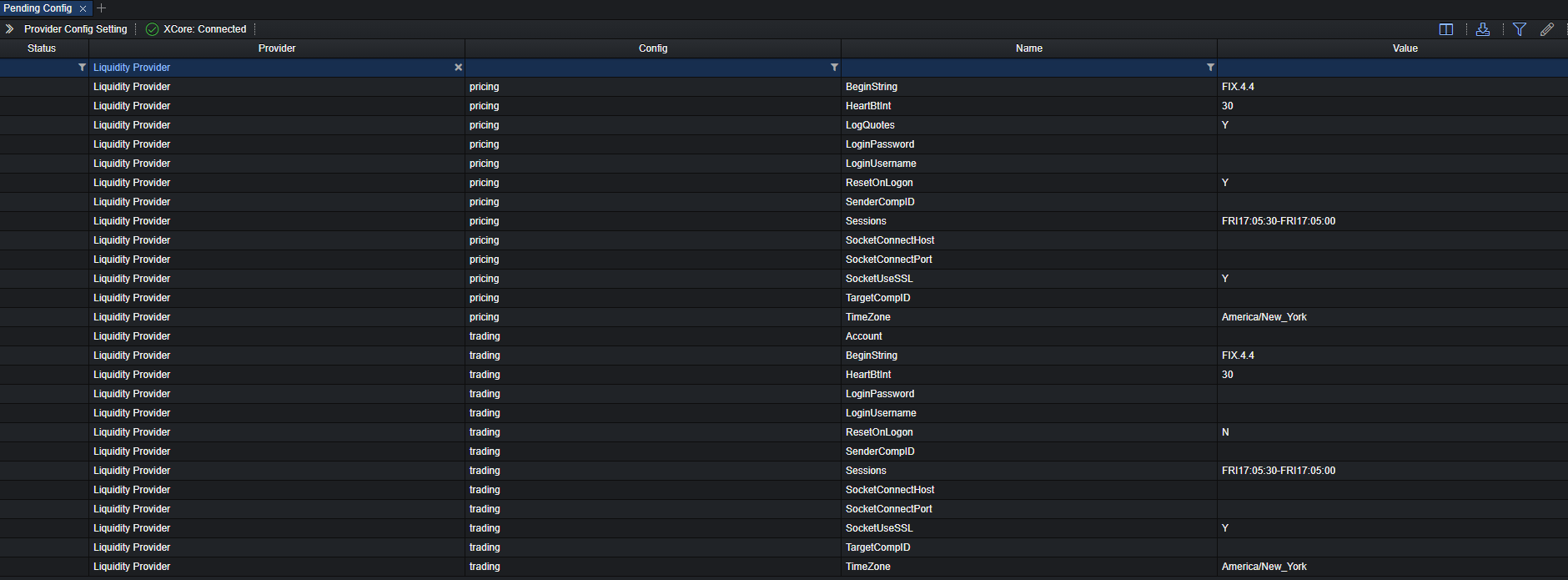
ProviderConfigSetting consists of name/value pairs that define the specific connectivity parameters for the connection. ProviderConfigSetting has the following attributes and can be accessed via pending config or real-time config:
| attribute | required | default settings | data type | description |
|---|---|---|---|---|
| provider | Y | – | INT | The ID of the Provider. |
| config | Y | – | TINYINT | The ID of the ProviderConfig. |
| name | Y | – | VARCHAR | The name of the parameter, spelled exactly as the adapter expects it. A stored parameter name does not prove that the adapter uses it. |
| value | Y | – | VARCHAR | The value of the parameter, as text. An empty value is not the same as an absent parameter. Recognized credential parameters are stored encrypted. |
FIX Parameters
The table below outlines a list of commonly used parameters applicable to FIX provider types:
| name | config type | data type | required | description |
|---|---|---|---|---|
| Account | pricing & trading | String | C | Account (tag 1) sent to the provider. Adapter-specific; CMC, for example, sends no Market Data Request without it. |
| BeginString | pricing & trading | String | Y | The FIX version. |
| HeartBtInt | pricing & trading | String | C | The heartbeat interval defines how often the system sends a signal to indicate it is still active. |
| EndDay | pricing & trading | String | C | Specifies the end day for a week-long session, to be used in combination with EndTime. |
| EndTime | pricing & trading | String | C | Specifies the end time of a daily session. When used in conjunction with EndDay, it defines the end time of a week-long session. |
| LoginPassword | pricing & trading | String | C | Authentication requirements depend on the provider adapter and counterparty specification. Configure LoginPassword where required. Using strong passwords is highly recommended. |
| LoginUsername | pricing & trading | String | C | Configure LoginUsername when required by the provider adapter or counterparty; TargetCompID does not universally replace an authentication username. |
| ResetOnLogon | pricing & trading | String | C | Defines whether sequence numbers are reset before receiving a logon response from the maker. The default settings are: • Pricing: ResetOnLogon is set to “Y” (Yes) to avoid sequence number conflicts and prevent resending of outdated market data. • Trading: ResetOnLogon is set to “N” (No), enabling the FIX protocol to recover missed execution messages, thus preventing trade breaks (PendingLegs). For more details, refer to provider_trade_setting.pending_limit and provider_trade_setting.pending_timeout. It is strongly recommended to omit this flag or adhere to these guidelines. |
| SenderCompID | pricing & trading | String | Y | SenderCompID refers to your CompID associated with this particular FIX session. Typically, it is set to the same value across all FIX sessions in which the session itself is the Acceptor. |
| Sessions | pricing & trading | String | C | Defines a custom XCore format string to streamline session time specification, eliminating the need to separately define StartDay, StartTime, EndDay, and EndTime. Recurring daily sessions adopt the format XXXStartTime-XXXEndTime, while weekly sessions are formatted as StartDayStartTime-EndDayEndTime. For example, a daily session might be denoted as XXX17:05:00-XXX17:00:00, and a weekly session as SUN17:05:00-SUN17:00:00. Times must include seconds (HH:MM:SS); without them the FIX session is not started. Only one session string is supported per configuration; a value containing a comma is rejected. Use separate trading configurations for several sessions. When Sessions is set, it overrides StartDay, StartTime, EndDay and EndTime. |
| SocketConnectHost | pricing & trading | String | Y | The host to connect to. |
| SocketConnectPort | pricing & trading | String | Y | The port to connect to. |
| SocketUseSSL | pricing & trading | String | C | Defines the use of SSL encryption for the connection. It is commonly configured as ‘N’ (No) for pricing connections and ‘Y’ (Yes) for trading connections. The default value is ‘N’ if not explicitly specified. |
| StartDay | pricing & trading | String | C | Specifies the start day for a week-long session, to be used in combination with StartTime. |
| StartTime | pricing & trading | String | C | Specifies the start time of a daily session. When used in conjunction with StartDay, it defines the start time of a week-long session. |
| TargetCompID | pricing & trading | String | Y | TargetCompID refers to the Counterparty’s CompID associated with this FIX session. |
| TimeZone | pricing & trading | String | C | Specifies the time zone for this session. If not defined, the session will default to the time zone set in system.timezone. |
| SenderSubID, TargetSubID | pricing & trading | String | N | Optional FIX header identifiers (tags 50 and 57) added to the session settings and to the logon. NOMURA trading config 1 rejects SenderSubID. |
Custom Parameters
The table below outlines parameters applicable to specific provider types:
| type | name | config type | data type | required | description |
|---|---|---|---|---|---|
| KUCOIN | Type | pricing | String | Y | Market segment for this session: spot or futures. |
| KUCOIN | Type | trading | String | Y | Market segment for this session: spot or futures. Must match the pricing config of the same provider. |
| KUCOIN | ApiKey | trading | String | Y | HMAC API key. |
| KUCOIN | ApiSecret | trading | String | Y | HMAC secret. |
| KUCOIN | ApiPassphrase | trading | String | Y | Passphrase set at key creation; itself HMAC-signed with each request. |
| KUCOIN | ApiKeyVersion | trading | String | N | API key signing version: 2 or 3. Default 3. |
| LMAX, LMAX_PERP | TradeLimit | trading | INT | N | Specifies the maximum number of trade requests per second that the system is allowed to send to LMAX or LMAX Perpetual. |
| IG_CFD_V3, IG_CFD_V2 | AllowScalingOverride | pricing | String | N | Resolves a scaling vs. ContractMultiplier (tag 231) mismatch. • N (default): conflict raised, book cleared, orders rejected. • Y: configured scaling overrides ContractMultiplier. |
| PRIMEXM_SIM | Interval | pricing | INT | N | Specifies the update interval in milliseconds for the PRIMEXM_SIM provider. The default setting is 1000 milliseconds. Supported values range from 100 to 3,600,000. |
| MAHI | XcorePrefix | trading | String | N | Specifies the value to be used as a prefix for the ClOrdID sent to the maker (e.g., 11=<XcorePrefix>-<ClOrdID>). |
| BINANCE | Type | pricing & trading | String | Y | Market segment: spot or futures. |
| BINANCE | ApiKey | trading | String | Y (Futures) | HMAC API key (Futures only). |
| BINANCE | ApiSecret | trading | String | Y (Futures) | HMAC secret (Futures only). |
| BINANCE | Ed25519PublicKey | trading | String | Y (Spot) | Binance API key registered with Ed25519. Required for Binance Spot trading. |
| BINANCE | Ed25519PrivateKey | trading | String | Y (Spot) | Base64 PKCS#8 Ed25519 private key. Required for Binance Spot trading. |
| - | syn_hedge_account | trading | String | N | Overrides the default synthetic hedge connector account defined in system.synthetics. Value format: connector|connector_account. |